If you are searching for how to prepare for a toddler speech evaluation, you are probably trying to do two things at once: help your child and calm your own brain. Most parents show up to that appointment carrying a mix of hope, worry, and a long list of half-formed questions. That is normal. A speech evaluation can feel important because it is important, but it does not need to feel mysterious.
Good preparation is not about performing for the clinician or proving that your concern is serious enough. It is about walking in with a clearer picture of how your child communicates across the week so the appointment can be more useful. A few notes, a few examples, and a few questions are usually enough.
Why Preparation Helps Before a Toddler Speech Evaluation
Toddlers do not always show their full communication style in a new room with a new person. Some become extra quiet. Some become silly and busy. Some cling to you for half the visit and then suddenly start interacting right when you think the session is going badly. That is one reason parent input matters so much. Your observations fill in the parts an evaluator cannot see in one hour.
Preparation also helps you leave with better answers. When a parent can describe how many words a child uses, whether they combine words, how they handle frustration, what they understand, and what routines are hardest, the discussion gets more specific. Instead of a vague sense that communication feels hard, you get a more grounded conversation about what your child is doing well, what may need support, and what next steps make sense.
What to Bring to a Toddler Speech Evaluation
If you want to know how to prepare for a toddler speech evaluation, start with the basics. Bring anything that helps your child settle in: a favorite snack, water, a comfort item, diapers or wipes if needed, and one familiar toy if transitions are hard. You do not need to pack a giant activity bag. The goal is comfort, not entertainment.
It also helps to bring any information that gives useful context. That might include pediatrician notes, hearing test results, early intervention paperwork, daycare or preschool concerns, or a previous evaluation if one exists. If your child hears more than one language, write that down too. Bilingual exposure is important context and should be part of the conversation, not something you feel defensive about.
Most important, bring your questions. Parents often assume they will remember everything in the moment, then the session ends and the brain goes blank. A short note in your phone is enough. You might want to ask what the evaluator is noticing about expressive language, understanding, play, speech sounds, gestures, or whether parent coaching, direct therapy, monitoring, or another referral fits best.
What to Track Before the Appointment
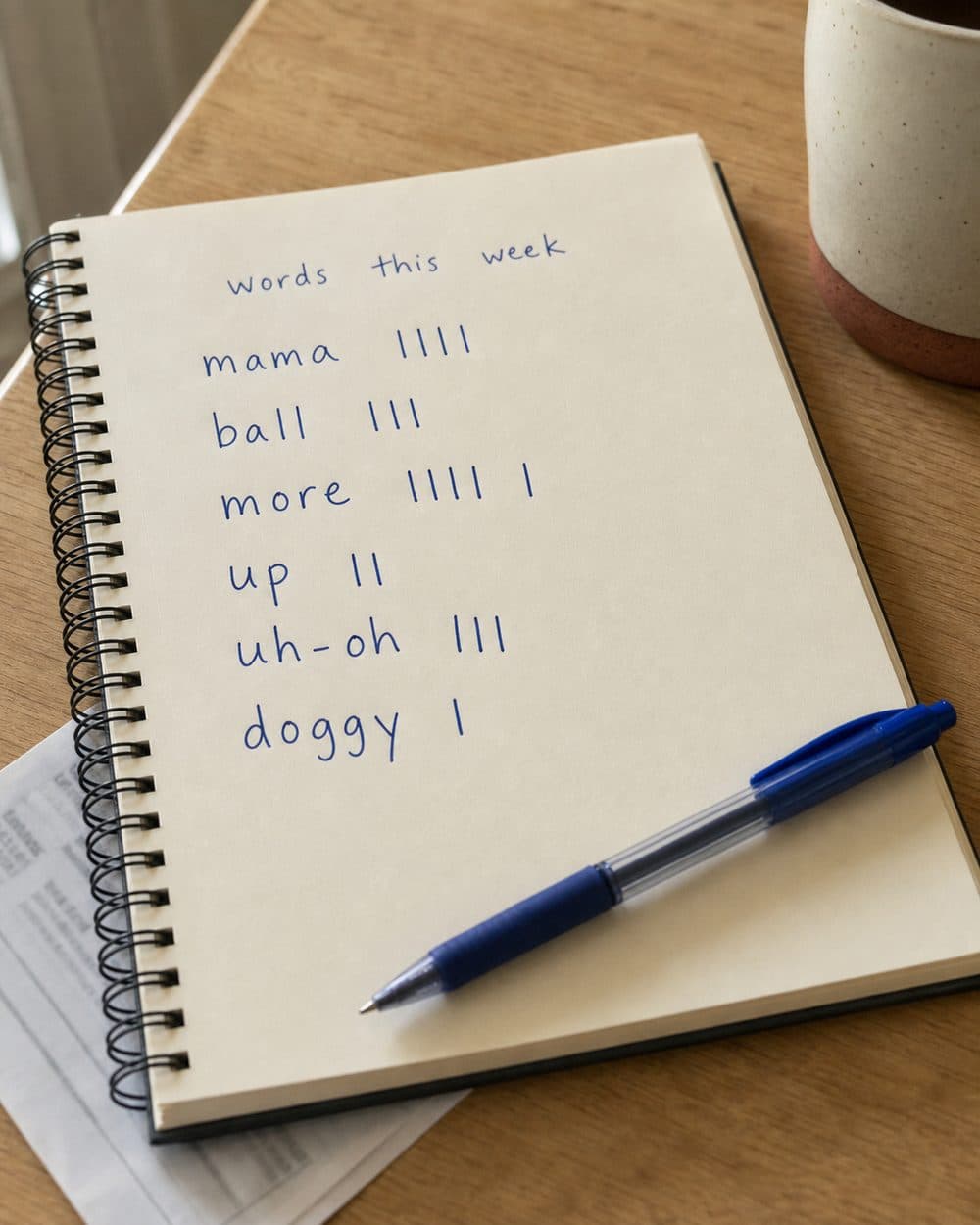
Before the visit, spend a few days noticing how your child communicates instead of only counting perfect words. Write down words, approximations, sound effects, signs, gestures, and repeated ways your child gets a message across. If your child says "ba" for ball every time they want to play, that matters. If they pull your hand to the fridge, point, look at you, and vocalize, that matters too.
It is also helpful to note what your child understands. Do they follow simple directions like "get your shoes" or "give it to daddy"? Do they point to body parts, familiar people, or favorite objects when named? Families sometimes focus so hard on spoken words that they forget comprehension gives important clues about the whole language picture.
Try to notice patterns around frustration and connection too. When does communication break down most often? Snack time, transitions, sibling play, public places, or bedtime? Does your child imitate sounds or actions? Do they copy gestures? Do they bring you things to share interest, or mostly communicate to request? These are the kinds of details that make an evaluation more useful than a simple milestone checklist.
You do not need a spreadsheet. A messy list on paper is fine. The purpose is not to create a perfect record. The purpose is to help the evaluator understand your actual child, not an anxious summary built from memory in the parking lot.
Questions to Ask During or After the Evaluation
A helpful evaluation should end with plain-language guidance. If the explanation feels too broad, ask for specifics. You can ask: What strengths stood out today? What concerns stood out? Do you think this looks like a language delay, a speech sound issue, or something more mixed? How much weight should I give what happened today versus what we see at home?
You can also ask what the next step would be if support is recommended. Some toddlers benefit most from parent coaching because they need stronger language models across the week. Others need direct therapy, monitoring, a hearing follow-up, or a broader developmental referral. If your family is in that in-between stage of not knowing whether to wait or act, this is the part that can bring real clarity.
Another useful question is what to do at home right now. Even when therapy is recommended, parents usually feel better when they leave with one or two clear strategies for meals, play, books, or transitions. That kind of practical guidance often matters as much as the formal recommendation.
What Not to Worry About Before the Visit
You do not need to coach your toddler for the appointment. Please do not spend the morning drilling flash cards, rehearsing animal names, or trying to make your child "show their best skills." A good toddler evaluation is built around play, observation, parent interview, and flexible tasks. The clinician is not expecting a polished performance.
You also do not need to wait until your notes are perfect. Families sometimes delay reaching out because they feel they need a cleaner word list, a longer history, or a more dramatic concern. If communication feels hard, that is enough reason to ask questions. Earlier clarity is usually more useful than months of second-guessing.
If your child has a quiet day, a clingy day, or a wiggly day, that does not ruin the process. Those responses are part of the picture too. A strong evaluator will consider your child's regulation, engagement, and comfort, not just whether they talked on command in a new setting.
Should I Bring a Word List?
Yes, if it helps you remember examples. A rough list of words, sounds, signs, and favorite phrases can be useful, especially for toddlers whose communication changes a lot from day to day.
What If My Child Barely Talks During the Evaluation?
That happens often. Toddler evaluations do not rely on one perfect performance. Parent report, play, gestures, understanding, imitation, and observation all help build the picture.
Should I Cancel If My Child Is Tired or Out of Routine?
Not necessarily. If your child is truly sick, rescheduling makes sense. But a slightly off day is common toddler life, and evaluators are used to working with that.
What If I Am Not Sure My Child Really Needs Help?
That uncertainty is one of the best reasons to get guidance. An evaluation does not force you into therapy. It gives you better information so your next decision feels calmer and more grounded.
A Calmer Way to Prepare for a Toddler Speech Evaluation
The simplest answer to how to prepare for a toddler speech evaluation is this: bring a little context, a few real examples, and the questions you do not want to forget. You do not need to arrive with perfect data or a perfect child. You just need enough information to help the evaluator see what daily communication actually looks like.
If you are local to Palos Verdes or the South Bay and you want help sorting out whether your child needs a full evaluation, parent coaching, or a more targeted home plan, that conversation can start simply. Clear support should feel warm, practical, and specific to your child, not overwhelming.